About This Template
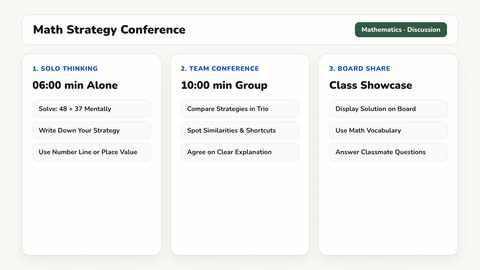
In math talks, mathematical reasoning matters more than quick answers. This template guides three learning phases: a problem with silent work, small-group strategy comparisons, and sharing multiple solutions.
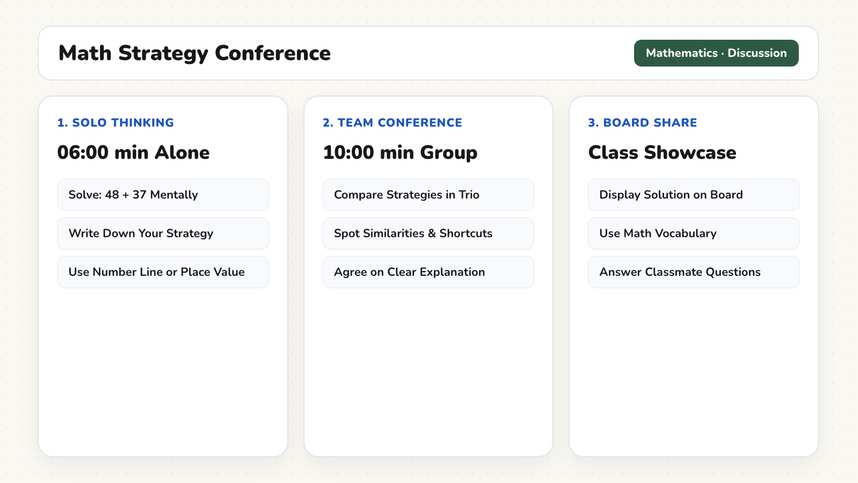
How It Works
- Launch the Problem (5 Minutes). A rich word problem or number string appears prominently on screen alongside the prompt: “Show your thinking using words, numbers, or pictures.” A reassuring note emphasizes: “There are multiple ways to reach the solution.”
- Independent Problem Solving (7 Minutes). The Work Phase widget displays silent individual work while the Timer counts down. Every student works independently on scrap paper, focusing on showing reasoning rather than rushing to a final answer.
- Small-Group Math Dialogue (10 Minutes). The second board slide guides small groups: students share their strategies around the table, including approaches that led to misconceptions, and select one strategy to explain to the whole class.
- Whole-Group Strategy Share (15 Minutes). The third slide uses the Random Name Picker to choose three student groups. Guiding listening questions appear on screen: “How does this method compare to mine?” and “What makes this approach efficient?”
- Classroom Synthesis (8 Minutes). The teacher records the different student strategies live in the Text widget. This comparison chart represents the true takeaway of the lesson rather than a single calculated answer.
Adaptations & Variations
In second-grade classrooms, adapt the prompt with smaller two-digit numbers and organize students into pairs instead of four-person groups. Comparing two visual models side-by-side provides manageable cognitive load before introducing complex multi-strategy discussions.
In upper elementary grades, keep the structured phases identical while introducing open-ended inquiry prompts. Provide a realistic scenario and ask students to determine the mathematical question themselves. For ideas on structuring teams smoothly, explore our guide to Organizing Group Work and use our Group Generator.
In special education settings, scaffold the first board slide with a visual graphic organizer: provide two solved steps with a prompt to complete the final step. Students participate fully in mathematical dialogue while bypassing the intimidation of a blank page.
For a universal three-stage protocol applicable across all academic disciplines, explore our Think-Pair-Share template.
Preparation
- None required. Problem prompts, timers, and discussion frames are fully configured across all slides.
- You can easily edit the problem text in the widget to match your current mathematics curriculum.
- Enter your class roster into the name picker if you want randomized student selections.
- Ensure every student has math journals or scrap paper ready at their desk.
Frequently Asked Questions
Are these whiteboard templates free?
Yes. All templates and all classroom tools are completely free to use without an account. Premium costs $2.49 per month and syncs your custom board layouts across devices, with the first month free. Student teachers receive permanently free Premium with verification.
Can I replace the sample problem?
Yes, simply click the text widget and type your current curriculum problem. The timer intervals, work phase indicators, and discussion stems remain ready to guide the lesson.
How do students share their work?
Students bring their notes or whiteboards to small groups. The template prompts them to compare different calculation paths, turning mistakes into valuable classroom learning.