About This Template
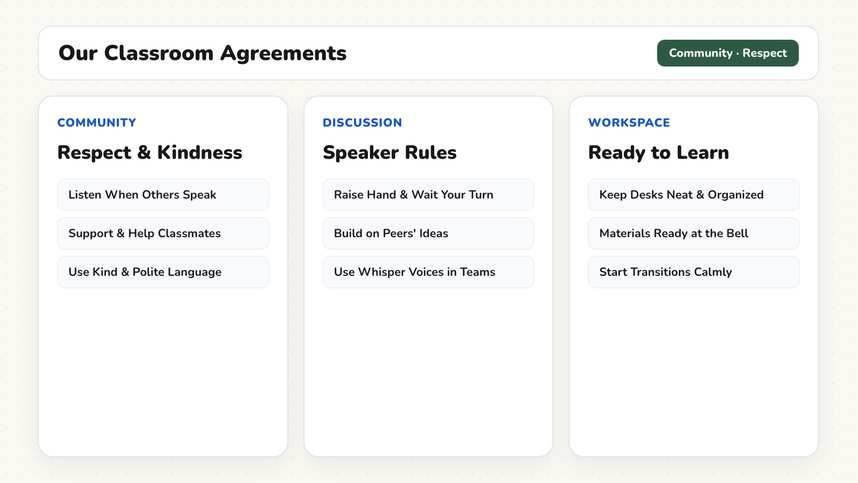
At the start of the school year, classes establish how they learn together. This template provides a collaborative draft to refine with students, along with a traffic light and marble jar.
How It Works
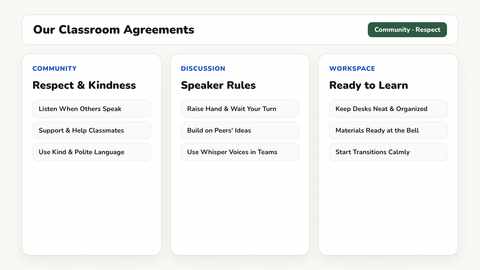
- Review Draft Rules (10 Minutes). Five core rules appear on the screen as a starting proposal. Read each guideline aloud and invite the class to explain what each norm looks like in practice. Keep this stage focused on understanding rather than rewriting.
- Collaborative Adjustments (15 Minutes). Students suggest refinements or phrasing that fits their classroom. Type modifications directly into the Text box on the screen so everyone sees the updated community agreement. Keep the list capped at five rules; adding a sixth means combining or replacing another.
- Establish Noise Levels (10 Minutes). The second board slide displays the Traffic Light with three labeled volume levels. Agree as a group on what Red, Yellow, and Green mean in your room and enter those definitions.
- Agree on Class Goals (10 Minutes). The third board slide presents the Marble Jar set to a target of thirty. The class decides together what collective actions earn a marble and what community celebration occurs when the jar is full.
Adaptations & Variations
In elementary grades, replace dense rule text with concise, positive phrases in child-friendly language. Pair each rule with an illustrative icon. The traffic light becomes the key visual cue: pointing to the screen replaces verbal reprimands, preserving classroom calm.
In secondary school, adopt a student-driven approach. Have students brainstorm behaviors that disrupt learning and convert those observations into positive commitments. Guidance on facilitating this conversation is available in our guide to Building Classroom Rules.
In special education classrooms, reduce the total to three essential rules. A short, predictable list provides greater safety and clarity; a similar minimalist approach is featured in our Reading Time template.
If you revisit classroom expectations after school breaks, pair this board with the Class Meeting template to resolve emerging social friction collaboratively.
Preparation
- None required. The template opens immediately with all three board slides ready to display.
- Optionally enter your preferred marble jar celebration reward before class begins.
- The traffic light requires no microphone setup; switch colors manually with one tap.
- Prepare paper if you want students to copy the finalized rules into their notebooks.
Frequently Asked Questions
Are these whiteboard templates free?
Yes. All templates and all classroom tools are completely free to use without an account. Premium costs $2.49 per month and syncs your custom board layouts across devices, with the first month free. Student teachers receive permanently free Premium with verification.
Can I edit the default classroom rules?
Yes, every line is fully editable on screen. The five rules are an initial proposal, not a rigid script. Adjust them alongside your students so agreements reflect your classroom community.
Which grade levels does this support?
Kindergarten through grade eight. For early elementary grades, use concise phrases paired with visual icons. In secondary grades, focus the discussion on student-identified learning barriers.